Most people don’t meet your business for the first time on your website. They meet you on a search results page.
They type your name into Google. Or they ask an AI tool if you’re legitimate. Or they just click whatever comes up first and make a judgement fast.
Here’s the frustrating part: Google and AI aren’t forming an opinion the way a person does. They’re just reflecting back whatever information exists online.
If you haven’t been intentional about that information, you’re leaving your reputation to chance.
This is where branded keywords play a crucial role.
What Branded Keywords Actually Are
Branded keywords are searches that include your business name or close variations of it. That includes:
- Your exact company name
- A shortened version of your business name that people use
- Common misspellings of it
- Names of products you created
A simple way to think about it is that if something only exists because your business exists, it is part of your branded search footprint.
Why Branded Searches Are Not Always “Just Navigation”
Some branded searches are navigational. Someone already knows where they want to go and they are using Google as the quickest route. That might be a login page, your homepage or your contact page.
But a big chunk of branded searches come from people who are researching. They have heard of you, maybe through a recommendation, an ad, a van they saw in town or a post on social media.
Now they are doing the trust check. They want to see reviews and proof that you are real. They want to see what other people say about you.
This matters even more now because lots of people are using AI to do that research for them.
AI tools can only reference what they can find. If the online picture of your business is thin, inconsistent or dominated by one loud negative voice, that is what gets repeated.
The Key Idea: Google And AI Can Only Work With What Exists
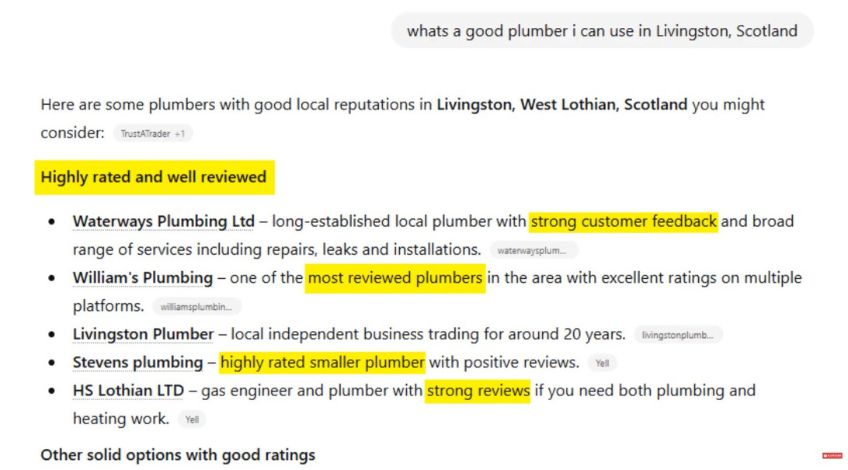
Here’s what you need to understand: Google and AI can’t invent context. They can’t fill in gaps. They can’t balance the story if only one side is visible.
Branded keyword SEO isn’t just about rankings. It’s about making sure the right sources, pages, profiles and mentions exist so your business gets represented fairly.
If one unhappy customer posts negative stuff across multiple sites and you haven’t built much else online, that negativity becomes the main thing people see.
If you have taken the time to build out credible assets, you give Google and AI more material to work with and you reduce the chance of one page defining your brand.
How Branded Keywords Are Used In SEO
Branded keyword SEO is about being intentional with what shows up when someone searches for you.
You are not trying to trick the algorithm. You are trying to make sure the internet has enough accurate, positive and useful information to represent your business properly.
1. Owning your branded search results
When someone searches your name, the ideal outcome is that the first page feels clear and reassuring.
It should show your official site, your main profiles, credible mentions and real evidence that you are active.
If you leave it to chance, you can end up with:
- Old pages you forgot existed
- Random directory listings with the wrong details
- Negative posts ranking higher than they should
- Thin results that make you look inactive
The goal is simple: Fill the results with assets you control or assets that fairly represent you, so there is less room for the wrong pages to dominate.
2. Building social media profiles that can rank for your name
Setting up your company’s social profiles is not just for posting updates. These profiles can rank for your branded keywords.
They also act as trust signals because they show that your business is real and active.
Good social profiles do multiple jobs at once:
- They add more owned results for your brand name
- They can push down results you do not want taking centre stage
- They feed consistent information that AI tools can pick up when describing your business
What should you post? You do not need to be clever, you only need to be real.
You can share photos of recent work, behind the scenes moments, customer reviews, your team on site, short explanations of how you work or anything that shows you are actively trading and doing good work.
If you do this consistently, the brand story people see in search starts to match the business you want them to experience in real life.
Social media platforms are also useful because they can drive visits back to your website. That matters because search visibility often improves when a page receives meaningful traffic.
Traffic can come from many places, including social media, paid ads, email marketing or other channels.
If more people land on your pages and engage, you are giving search engines stronger behavioural signals that your site is useful and relevant.
3. Publishing digital press releases to shape the narrative
Digital press releases can work well for branded keywords because they create news style articles about your business across multiple online publications.
The benefit is not just exposure but also control.
A press release gives you a structured way to put your best foot forward, in your own words, while also generating authoritative mentions of your business name.
Those mentions can support branded rankings and they give AI tools more reliable material to reference when people ask about your company.
This is especially helpful if your business is new, rebranded or expanding into new locations or services and you want the internet to catch up with your latest story.
4. Generating reviews where people actually look
Reviews are one of the first things people click when they search a brand name. They want to know what other customers experienced before they commit.
Businesses often do not ask for reviews and unhappy customers are more likely to post than happy ones. If you do nothing, the review profile you end up with is often biased.
A review generation strategy fixes that. It makes asking for reviews a normal part of your process, rather than something you remember once every few months.
For most local businesses, Google Business Profile should be the priority because it often shows on the results page alongside your website when someone searches your company name.
That said, you should not rely on one platform only. Reviews on major platforms such as Trustpilot can also rank for your branded keywords.
The aim is to build a spread of real reviews in the places your customers trust, so your branded searches consistently lead to proof.
Reviews are also increasingly used by AI systems when deciding which businesses to recommend.
If an AI tool is trying to work out whether you are credible, reviews are one of the clearest signals it can reference.
Be Intentional About What Shows Up
Branded keywords are not an advanced SEO trick. They are a reflection of how people behave.
People search your name when they are deciding if you are trustworthy. Google and AI answer based on what they can find.
Your job? Make sure there’s enough good and accurate information available.
If you do nothing, you are relying on chance. If you do a few basics consistently, you give your business the best possible chance of making a strong first impression.
Do those things and branded searches stop being a risk. They start becoming one of your strongest trust builders in SEO.