

When people first learn about on page SEO, they usually focus on keywords.
They learn where to place them, how often to use them and how to structure a page so Google can understand what the content is about.
What often gets missed is the role of the URL. It looks simple on the surface, yet it has a direct impact on how easily a page can rank.
This is where query strings start causing trouble.
They hide inside URLs, look technical and innocent, yet quietly make your pages harder for Google to understand.
Why Your URL Is One Of Your Strongest SEO Signals
Google relies on clear signals to understand the topic of a page. Your title tag and H1 tag already play a big part in this.
Your URL is the third element in that trio. When the three match, you give Google a strong sense of confidence that the page is relevant.
A clean URL should tell you the topic without needing to click.
If you read it out loud and instantly know what the page covers, Google will know as well.
Query strings break that clarity.
What Query Strings Are And Why They Exist
A query string is the small section of code that appears after a question mark in a URL. It might look like this:
- ?id=123
- ?p=421
- ?category=plumbing
These bits are usually created by databases and tracking systems. They help websites pass information behind the scenes.
They were never designed to describe content or communicate the topic of a page.
This is the core reason they weaken SEO. Behind the scenes data does not help Google understand what the page is about.
Query Strings Confuse Google
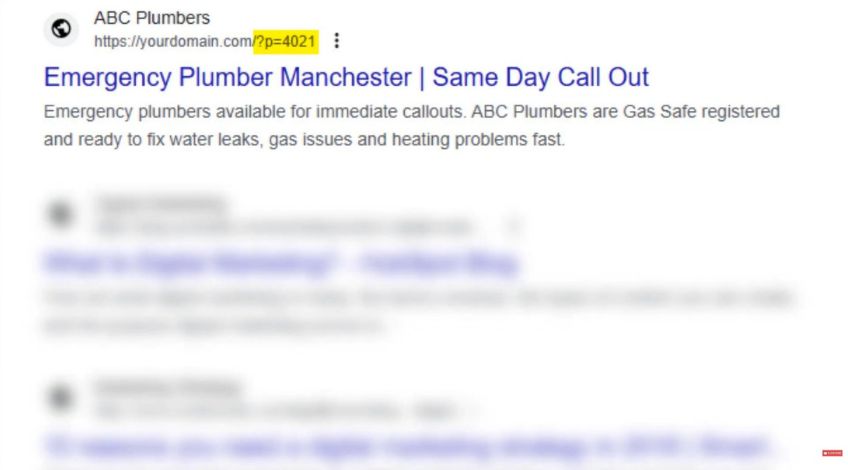
Google looks at the URL as a clue. It expects to see real words, especially your target keyword.
When it sees numbers and symbols instead, things get difficult.
Query strings give no clear information about the page. They make your URLs harder to understand and remove a ranking signal that cleaner URLs provide.
If your competitors have simple URLs built around their keywords and you have URLs full of query strings, Google will favour them.
Imagine Google has to choose between:
- yoursite.com/emergency-plumber-manchester
- yoursite.com/?p=421
The first URL spells out the topic.
The second one is a mystery.
Even if the content is strong, the URL weakens the overall page.
How Query Strings Sneak Into Your Site
They appear most often when a page is duplicated inside your CMS and the system adds numbers to avoid conflicts.
Additionally, a developer may use dynamic URLs for convenience. Filters or tracking tools can create new variations of the page.
Sometimes, a template automatically generates database-based URLs. As a result, you will end up with URLs like “emergency-plumber-manchester-2” and “service-page-3”.
If the page is not actually about those topics any more, this creates confusion.
Google might index the wrong page or fail to index the one you want to rank.
Why Clean URLs Are Always Better
Clean URLs help both humans and search engines. They are easier to scan, easier to type, easier to trust and easier for Google to classify.
The shorter and more descriptive a URL is, the stronger the SEO foundation.
Query strings are fine for sorting products on an ecommerce page, tracking specific campaigns and filtering content without creating separate pages.
These are not the URLs that need to rank. They only support the user experience.
Your service pages, category pages and main content pages should stay clean.
How To Fix Query String Issues
If you find you have pages that rely on query strings, you can clean them up by:
- Creating a short descriptive URL that uses real words
- Updating the page to use the new URL
- Setting up a 301 redirect from the old query string version to the new one
This keeps the page’s SEO value and helps Google quickly understand the correct structure.
Why Cleaning Up Your URLs Is Worth It
Query strings are useful for developers but unhelpful for SEO. They make URLs harder to read and harder for Google to interpret.
If a URL cannot communicate the topic of the page instantly, rewriting it is usually worth the effort.
When your URLs are clean, descriptive and built around real words, your site becomes easier for both people and search engines to understand.
And as more people rely on AI assistants, clear URLs make it easier for those tools to understand and trust your pages.