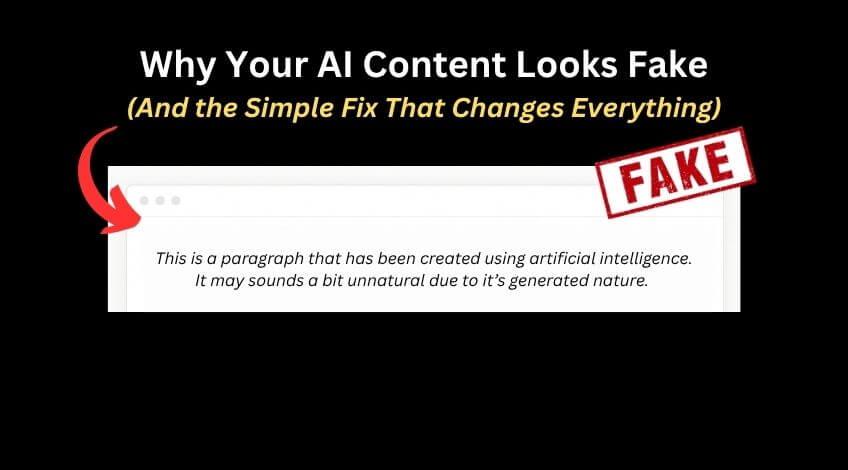
You’ve received a message from someone and thought “You didn’t write that. ChatGPT did”.
Remember how that felt? Inauthentic. Like they didn’t care enough to actually write to you. You probably struggled to trust what they were saying because it wasn’t coming from them.
If you’re using AI content on your website, your customers are having that exact same experience.
They’re reading your stuff and they know it’s AI. Trust disappears and they move on.
Here’s the worst part. Google struggles to index a lot of this stuff because it reads as programmatic instead of human. So not only are your customers not connecting with it, search engines aren’t either.
The good news? There’s a simple fix. But first, you need to know what’s giving you away.
The Three Dead Giveaways Everyone Spots
The Oxford Comma
The Oxford comma is a comma that goes before “and” or “or” in a list.
“I specialise in search engine optimisation, AI optimisation, and public speaking”.
That comma before “and”? That’s the Oxford comma.

Here’s the problem. Nobody was usually doing this before ChatGPT started doing it for us.
Your local plumber down the road who didn’t go to university is suddenly creating content at university standard. It’s obvious that AI is doing it. We’ve all caught on because no one was doing it before.
Think about how you actually write emails to customers. Do you carefully place commas before every “and” in a list? Probably not. You just write naturally.
Even though the Oxford comma is grammatically correct, get rid of it. It’s a red flag that screams “I used AI for this.”
The Rule of Three
People remember things easier when you give it to them in threes. ChatGPT knows this. So it takes it to the extreme.
Every single list and benefit. Every time you talk about services. It wants to give back three things.
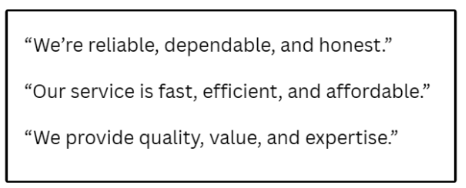
Sounds good on the surface. But people didn’t used to talk like that.
Before AI, someone might just say “we’re an honest company” and carry on from there. Or they’d list five things. Or two. The number varied because humans don’t follow rigid patterns.
The average person is starting to see these patterns now. They read a website and spot the threes everywhere. It’s incredibly programmatic.
Go through your content. When you’re listing attributes or properties, don’t always use three. Sometimes use four. Use five. Sometimes use two. Sometimes just use one and move on.
Break the pattern. That’s what real human writing looks like.
Em Dashes
This is the most obvious one.
I don’t even know how to do an em dash on my keyboard. There isn’t a key for it. Nobody was doing this before ChatGPT.
Regular hyphens existed. Some writers used them naturally in their content. But these super long hyphens that look like someone stretched a regular hyphen? Dead giveaway that it’s AI.

You’ll see them everywhere in AI generated content. Mid sentence, the AI throws in one of these long dashes to add a pause or insert extra information. It looks sophisticated. But it’s not how most people actually write.
It breaks the connection with your reader because they know you didn’t write it. Get rid of them.
Why Your Readers Spot This Immediately
Here’s something most people don’t think about.
Your customers have been using ChatGPT themselves. They’ve seen these patterns in their own AI outputs. So when they land on your website and see the same patterns, alarm bells ring.
It’s not a conscious thing. They don’t sit there thinking “Ah yes, I see an Oxford comma and an em dash, this must be AI.” It’s more subtle than that.
They just get a feeling. Something feels off. The content doesn’t sound like a real person wrote it. It sounds too polished in a weird way. Too structured. Too perfect. And somehow, quite robotic.
And once that feeling hits, trust evaporates.
Think about it from their perspective. If you can’t be bothered to write your own website content, what else are you cutting corners on? If you’re using AI to communicate with them before they’ve even become a customer, what happens after they pay you?
These thoughts might not be fully formed in their head. But the feeling is there. And feelings drive decisions.
The Google Problem
It’s not just about fooling readers. There’s a bigger issue.
Google struggles to index content that reads as programmatic instead of human. The search engines want content written by real people with real expertise. They want to serve up genuinely helpful stuff, not pages of AI generated fluff.
When Google’s algorithms detect patterns that suggest AI content, they’re less likely to rank it well. They might not index it at all.
So you’ve got this double problem. Your customers don’t trust AI content when they read it. And Google doesn’t want to show it to them in the first place.
You’re losing on both ends.
The businesses that tighten up their AI content and make it sound more natural aren’t just building trust with readers. They’re giving themselves a better shot at actually ranking for the stuff they’re writing about.
The One Setting That Fixes It
I can’t give you something that makes AI content perfect the first time. That doesn’t exist. Anyone who tells you otherwise is lying.
But I can give you something that gets you there much quicker and saves you a lot of editing time.
Here’s what to do:
- Go into ChatGPT settings. Find personalization. Look for custom instructions.
Add this:
- “Don’t use em dashes. Don’t use the Oxford comma. Vary list length so it doesn’t always settle into groups of three. Avoid marketing style triads.”
That’s it.
What happens now is ChatGPT adjusts its output based on these instructions. Every time you use it, these rules apply. You don’t have to remember to add them to each prompt.
Your content will come back much closer to what you actually wanted to create. The first draft will be cleaner. More natural sounding. Fewer obvious AI patterns.
Remember: It’s not perfect. You’ll still need to edit. You’ll still need to add your own voice and personality. But you’re starting from a much better place.
The amount of time you save on editing adds up fast.
What To Do With Content You’ve Already Published
If you’ve got AI content already live on your website, don’t panic. But do take action.
- Go through your existing pages. Look for the patterns we’ve talked about. Oxford commas everywhere. Everything in threes. Em dashes scattered throughout.
- Start with your most important pages. Homepage. Main service pages. Any page that gets decent traffic.
- Read them out loud. Does it sound like something you’d actually say?
- Or does it sound like a robot wrote it?
Where you spot the patterns, edit them out. Remove the Oxford commas. Break up the threes. Replace em dashes with regular punctuation or rewrite the sentence entirely.
This takes time, but it’s worth it. Each page you fix is a page that now sounds human. A page your customers can actually connect with.
The Bigger Picture
Here’s what most people miss.
AI is a tool. A powerful one. It can help you create content faster than ever before. But it’s still just a tool.
The problem isn’t using AI. The problem is using AI badly.

When you let ChatGPT write your content and publish it without editing, you’re not saving time. You’re damaging trust. You’re hurting your search rankings. You’re making your business look lazy.
But when you use AI as a starting point and then shape it into something that sounds like you? That’s smart. That’s efficient. That’s using the tool properly.
The businesses winning right now aren’t the ones avoiding AI entirely. And they’re not the ones publishing raw AI output. They’re the ones in the middle. Using AI to get a first draft, then editing it to sound human.
That’s where you want to be.
Taking Your AI Content Further
Adjusting your ChatGPT settings is a solid first step. It immediately improves your output quality.
But there’s more to it than just avoiding obvious patterns.
You need to think about your brand voice. What does your business actually sound like? Friendly? Professional? Casual? Technical? Your AI content should match that.
You need to think about your audience. How do they talk? What words do they use? Your content should mirror their language.
You need to think about expertise. Anyone can list services. But explaining the thinking behind those services? Sharing the considerations involved? That shows real knowledge. That’s what builds trust.
These things take more than a settings change. They take intentional effort. But they’re what separate mediocre AI content from content that actually works.
Why This Matters More Than Ever
AI adoption is accelerating. More businesses are using it every day. Which means more AI content flooding the internet.
Many of it is obvious and sounds the same. Most of it fails to connect.
The businesses that stand out are the ones producing content that sounds human. Those with content that builds trust and content that demonstrates real expertise.
Right now, that’s not hard to achieve. Just being slightly better than obvious AI content puts you ahead.
But the window is closing. As more people catch on and start editing their AI output, the bar will rise. What passes for “good enough” today won’t cut it tomorrow.
The time to fix your AI content is now. Not next month. Now.
Your customers can smell fake content from a mile away. And when they do, they’re gone.
If your content doesn’t sound like you, why would anyone trust what you’re saying?